The best emergency radios for camping help you stay informed when storms, outages, or weak cell service cut you off from reliable updates. The models in this roundup combine weather alerts with practical backup features such as hand cranks, solar charging, flashlights, and phone power.
Use the guide below to compare power options, battery capacity, alert coverage, portability, and ease of use before choosing a radio for your camping kit.
Contents
- Best 10 Emergency Radios for Camping Picks for 2026
- Balanced Emergency Pick – Midland ER310 Weather Radio
- Compact Battery Pick – PRUNUS J161 NOAA Radio
- Lightweight Power Pick – RunningSnail MD-088s Crank Radio
- High-Capacity Outdoor Pick – Roxicosly CR1030 Weather Radio
- High-Capacity Pick – Leaton 10000mAh Hand Crank Radio
- Versatile Reception Pick – Kaito KA500 Multi-Band Radio
- Compact Value Pick – FosPower A1 NOAA Weather Radio
- Best All-Around Alert Coverage – Raynic 5000mAh Weather Radio
- Best Heavy-Duty Pick – OnLyee 12000mAh Emergency Radio
- Best for Private Listening – Eoxsmile NOAA Alert Radio
- How We Picked the Best Emergency Radios for Camping
- Quick Comparison
- Key Buying Factors for Emergency Radios for Camping
- Who Should Buy Which Emergency Radios for Camping?
Best 10 Emergency Radios for Camping Picks for 2026
Balanced Emergency Pick

- AM/FM and NOAA weather scan with alerts
- Solar power plus six included AA batteries
- Flashlight, SOS function, and dog whistle
Best For: Campers wanting versatile emergency features and multiple power options
Compact Battery Pick

- Seven NOAA bands plus AM/FM reception
- Runs on two AA batteries
- Compact 0.24-pound design with lanyard
Best For: Light packers needing simple weather and news access
Lightweight Power Pick
RunningSnail MD-088s Crank Radio

- Hand crank, solar, and rechargeable power
- 2000mAh battery with USB phone charging
- AM/FM/NOAA reception and LED flashlight
Best For: Campers seeking portable charging and emergency lighting
High-Capacity Outdoor Pick
Roxicosly CR1030 Weather Radio

- Listed 12000mAh battery and five charging methods
- 5W flashlight plus 12-LED reading lamp
- IPX6 waterproofing and NOAA alerts
Best For: Extended outdoor use and wet-weather emergency preparedness
High-Capacity Pick
Leaton 10000mAh Hand Crank Radio

- Large 10000mAh internal battery
- Solar, hand-crank, and USB-C charging
- Manual NOAA tuning; IPX6 splash resistant
Best For: Campers needing extra backup power
Versatile Reception Pick

- AM/FM, shortwave, and NOAA channels
- Multiple charging and battery options
- Flashlight, reading lamp, and SOS beacon
Best For: Campers wanting broad reception and flexibility
Compact Value Pick
FosPower A1 NOAA Weather Radio

- Lightweight 310-gram design
- Solar, hand-crank, USB-C, and AAA power
- 2000mAh bank with SOS and dual lights
Best For: Backpackers wanting basic emergency features
Best All-Around Alert Coverage

- Automatic NOAA alert scanning
- Six charging options, including solar and hand crank
- Flashlight, reading lamp, SOS, USB charging, and headphone jack
Best For: Campers wanting broad alerts and flexible backup power
Best Heavy-Duty Pick
OnLyee 12000mAh Emergency Radio

- 12,000mAh rechargeable battery
- Large solar panel and hand-crank backup
- IPX6 protection, 5W flashlight, and 120dB SOS alarm
Best For: Extended off-grid trips and rugged emergency kits
Best for Private Listening
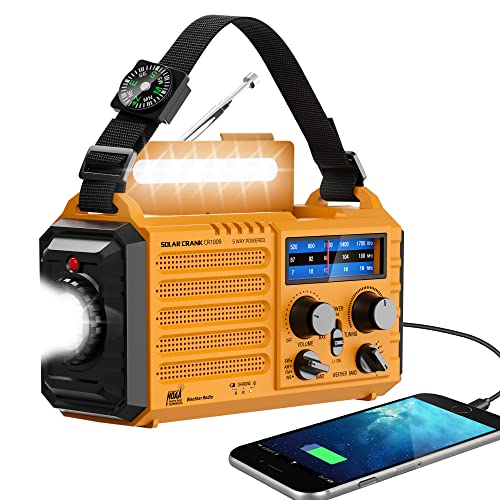
- NOAA alert alarm with flashing red light
- AM/FM/SW and seven NOAA weather channels
- Headphone jack, compass, lights, and USB charging
Best For: Campers wanting private listening and versatile radio coverage
Balanced Emergency Pick – Midland ER310 Weather Radio
For campers who want a versatile option among emergency radios for camping, the Midland ER310 combines AM/FM and NOAA weather scanning with several backup power options. Its built-in flashlight and ultrasonic dog whistle add useful emergency features, although it is not water resistant.
Best For: Campers wanting a feature-rich radio with multiple power sources and emergency signaling tools.
Pros:
- Supports AM/FM and NOAA weather scan with alerts.
- Offers multiple power sources, including solar power and six included AA batteries.
- Includes an SOS emergency flashlight and ultrasonic dog whistle.
- USB connectivity can support compatible smartphones and tablets.
Cons:
- Not water resistant, so it needs protection from rain and splashes.
- Its 16-ounce, larger-bodied design is less compact than pocket radios.
The ER310 is a practical all-around choice when emergency signaling and flexible power matter more than waterproofing or minimum pack size.
Compact Battery Pick – PRUNUS J161 NOAA Radio
The PRUNUS J161 is a straightforward choice for emergency radios for camping when low weight and simple operation are priorities. It covers seven NOAA weather bands along with AM and FM, runs on two AA batteries, and includes a lanyard for easy carrying.
Best For: Backpackers and campers who want a lightweight, battery-powered radio for weather and news updates.
Pros:
- Very compact and lightweight at 4.7 by 2.8 by 1.2 inches and 0.24 pounds without batteries.
- Receives seven NOAA weather bands plus AM and FM.
- Uses only two AA batteries, which are easy to pack as spares.
- Simple three-control layout and headphone jack support convenient listening.
Cons:
- Does not support automatic NOAA alert notifications.
- Battery-powered design does not provide solar, crank, or phone-charging capability.
- Its listed tuner type is FM, despite the product also supporting AM and NOAA bands.
Choose the J161 for a no-frills information tool that takes up very little room, but look elsewhere if you need emergency lighting, charging, or automatic alerts.
Lightweight Power Pick – RunningSnail MD-088s Crank Radio
The RunningSnail MD-088s is a strong fit for emergency radios for camping because it pairs AM/FM/NOAA reception with hand-crank and solar charging. A built-in 2000mAh battery, USB phone charging, and a bright LED flashlight provide useful support when outlets are unavailable.
Best For: Campers who want a compact crank radio with lighting and basic emergency phone charging.
Pros:
- Provides three power modes: hand crank, solar panel, and built-in rechargeable battery.
- Includes a 2000mAh battery with USB charging for compatible smartphones.
- Features AM/FM/NOAA reception and a retractable antenna for signal sensitivity.
- Lightweight, water-repellent body with a 1W LED flashlight.
Cons:
- The 2000mAh battery offers less capacity than larger emergency power banks.
- Water-repellent construction is not the same as fully waterproof protection.
- Its compact flashlight may provide less coverage than larger lamp-style radios.
With a useful balance of portability, renewable charging, lighting, and phone support, the MD-088s is well suited to short camping trips and emergency kits.
High-Capacity Outdoor Pick – Roxicosly CR1030 Weather Radio
The Roxicosly CR1030 is built for campers who want an emergency radio for camping with substantial backup power and lighting. It combines a listed 12000mAh battery, large solar panel, hand crank, USB-C charging, NOAA alerts, and IPX6 waterproofing in a rugged outdoor design.
Best For: Extended camping, blackout preparation, and wet-weather use where power and lighting capacity matter.
Pros:
- Offers five charging methods, including built-in battery, USB-C, solar, hand crank, and AAA batteries.
- Includes a listed 12000mAh battery for phone charging and other backup power needs.
- Provides a 5W adjustable flashlight and a 12-LED reading lamp.
- Supports AM/FM and seven NOAA bands with alerts, plus an SOS alarm.
Cons:
- At 824 grams, it is considerably heavier than compact handheld radios.
- Larger dimensions may take up meaningful space in a backpack.
- The extensive feature set may be more than casual campers need.
The CR1030 is the most capable option here for power, lighting, and weather protection, but its larger, heavier build favors vehicle camping or basecamp use over ultralight trips.
High-Capacity Pick – Leaton 10000mAh Hand Crank Radio
For campers who want emergency radios for camping with extra device-charging capacity, the Leaton combines NOAA and AM/FM reception with a 10000mAh internal battery, solar and hand-crank charging, lighting, and a compass. Its IPX6 rating helps with splashes, though it is not designed for immersion or heavy rain.
Best For: Campers, RV travelers, and emergency kits that prioritize a larger backup battery.
Pros:
- 10000mAh battery can provide approximately 1–1.5 iPhone 14 charges, depending on conversion loss and device efficiency.
- Offers USB-C, solar, and hand-crank charging options.
- Includes a three-mode flashlight, reading lamp, compass, and NOAA/AM/FM reception.
- Compact 1.1-pound design with IPX6 splash resistance.
Cons:
- NOAA listening requires manual tuning and does not include SAME or automatic alerts.
- IPX6 protection is for water spray and splashing, not immersion or heavy rain.
- Actual phone-charging capacity varies with conversion loss and device efficiency.
The Leaton is a feature-rich choice when battery capacity matters more than automatic weather alerts. Its compact build and multiple charging methods make it practical for camping and emergency storage, while the manual NOAA tuning is an important limitation to understand.
Versatile Reception Pick – Kaito KA500 Multi-Band Radio
The Kaito KA500 is one of the more versatile emergency radios for camping, with AM/FM, two shortwave bands, and seven pre-programmed NOAA weather channels. It also supports hand-crank, solar, AA-battery, and compatible wall-power options, giving campers several ways to keep it running.
Best For: Campers who want broad radio reception, multiple power options, and a durable traditional design.
Pros:
- Receives AM, FM, two shortwave bands, and seven pre-programmed NOAA channels.
- Supports hand-crank, solar, three AA batteries, USB input, and 5V AC/DC input with the appropriate adapter.
- Includes a flashlight, five-LED reading lamp, SOS beacon, and USB device-charging output.
- Impact-resistant, water-resistant ABS housing and a 14.5-inch telescoping antenna.
Cons:
- Three AA batteries are required but not included.
- Wall power requires an adapter that is sold separately.
- Its 8.3-inch length is less compact than the other listed options.
The KA500 stands out for reception flexibility and its long antenna, making it suitable for campers who listen beyond local AM/FM stations. It is a strong all-purpose option, but remember to pack AA batteries and account for the separately sold wall adapter.
Compact Value Pick – FosPower A1 NOAA Weather Radio
The FosPower A1 is a compact choice for emergency radios for camping, pairing AM/FM/weather-band reception with solar and hand-crank charging, a 2000mAh power bank, an SOS alarm, and two lighting sources. Its small 310-gram design is convenient for backpacks and emergency kits.
Best For: Campers seeking a lightweight radio with basic device charging and emergency lighting.
Pros:
- Compact 6.2-inch design weighing about 310 grams.
- Uses solar, hand-crank, USB-C, and four AAA batteries for power and recharging.
- Includes a 2000mAh power bank, SOS alarm, 1W flashlight, and four-LED reading light.
- Backed by a limited lifetime warranty.
Cons:
- The 2000mAh power bank offers less capacity than the Leaton’s 10000mAh battery.
- Four AAA batteries are required when using that power source.
- Supplied information identifies the housing as water resistant but does not provide a specific IP rating.
The FosPower A1 is a practical lightweight option for short trips, day hikes, and compact emergency kits. It covers the essentials—weather reception, backup charging, lighting, and an SOS alarm—without the larger size or battery capacity of some alternatives.
Best All-Around Alert Coverage – Raynic 5000mAh Weather Radio
For campers who want broad reception and multiple backup charging methods, the Raynic is a versatile choice among emergency radios for camping. It combines automatic NOAA alerts with AM/FM/SW reception, lighting, and phone charging in a portable, water-resistant design.
Best For: Campers who prioritize automatic weather alerts, flexible charging, and private listening.
Pros:
- Automatically scans for emergency and weather alerts, including while in standby mode.
- Offers six charging options, including rechargeable battery, solar, hand crank, USB, AC adapter, and three AAA batteries.
- Includes a 3W flashlight, 2.5W reading lamp, SOS alarm, USB phone charger, and headphone jack.
- Large LCD display shows battery level and tuning frequency.
Cons:
- AAA batteries are not included.
- Its IPX3 water resistance is more limited than fully waterproof designs.
The Raynic stands out as a balanced camping radio for staying informed after dark or during changing weather. Its automatic alerts and six power options add practical redundancy, while the headphone jack and compact 1.2-pound build make it convenient for shared campsites.
Best Heavy-Duty Pick – OnLyee 12000mAh Emergency Radio
The OnLyee is built for campers who want substantial reserve power in their emergency radios for camping. Its 12,000mAh battery, oversized solar panel, rugged protection, and 5W lighting system make it suited to extended off-grid use and emergency kits.
Best For: Campers, RV travelers, and preparedness-focused buyers who want maximum battery capacity and rugged protection.
Pros:
- Large 12,000mAh rechargeable battery supports the radio, lights, and emergency phone charging.
- Uses an 8500mm² solar panel, high-torque hand crank, USB-C input, and three AAA batteries as power options.
- Provides a 5W flashlight, foldable reading lamp, and 120dB SOS alarm with flashing beacon.
- Rated water-resistant with IPX6 protection and described as dustproof and shockproof.
Cons:
- At 1.6 pounds, it is heavier than some compact camping radios.
- AAA batteries are listed as a backup option but may require separate replacement batteries.
Choose the OnLyee when battery reserve and durability matter more than minimizing pack weight. Its high-capacity battery and large solar panel are useful for longer trips, while the loud alarm, bright lighting, and protective enclosure add emergency versatility.
Best for Private Listening – Eoxsmile NOAA Alert Radio
The Eoxsmile offers a practical mix of weather monitoring, entertainment, and campsite lighting for shoppers comparing emergency radios for camping. Its NOAA alert function, AM/FM/SW reception, headphone jack, compass, and five power sources make it a flexible companion for outdoor trips.
Best For: Campers who want private listening, multiple radio bands, and a lightweight emergency tool with built-in lighting.
Pros:
- NOAA alerts trigger a loud alarm and flashing red light when severe weather warnings are issued.
- Receives AM, FM, shortwave, and seven NOAA weather channels.
- Includes a 3W flashlight, adjustable 2.5W reading lamp, USB phone charger, and compass.
- Offers solar, hand-crank, USB-C, rechargeable-battery, and AAA-battery power options.
Cons:
- AAA batteries and the 5V/2A power plug are not included.
- The analog pointer display may be less precise than a digital tuning display.
The Eoxsmile is a strong fit for campers who value listening flexibility and simple outdoor utility. Its headphone jack helps avoid disturbing travel companions, while the alert system, compass, lights, and multiple charging methods cover common campsite and emergency needs.
How We Picked the Best Emergency Radios for Camping
We focused on radios that provide useful emergency communication features in outdoor conditions, including NOAA weather access, AM/FM reception, dependable backup charging, and built-in lighting. We also considered portability, battery capacity, charging flexibility, controls, and features that are practical at a campsite rather than simply adding complexity.
Because camping needs vary, this list includes compact battery-friendly radios alongside larger solar and hand-crank models with high-capacity batteries. A radio should remain useful even when one charging method is unavailable, so versatile power options received particular attention.
Quick Comparison
| What to Compare | Best For |
|---|---|
| Hand-crank charging | Short-term emergencies and cloudy conditions |
| Solar charging | Extended trips with regular sunlight |
| Replaceable batteries | Simple, predictable backup power |
| Large internal battery | Running lights or charging a phone |
| NOAA weather alerts | Storm awareness and changing conditions |
| AM/FM/SW reception | Broader station access and travel use |
Key Buying Factors for Emergency Radios for Camping
Power and Charging Options
A hand crank is valuable when batteries and outlets are unavailable, but it is usually best viewed as an emergency reserve rather than the primary charging method. Solar panels can help on longer trips, while replaceable AA or AAA batteries offer predictable performance. Models with USB input or output add flexibility for charging from a power bank or topping up a phone.
Battery Capacity and Charging Output
Higher-capacity radios can provide longer runtime and more phone-charging ability, but they are often larger and heavier. Check whether the stated capacity is expressed in mAh or another unit, and remember that real-world phone charging varies by cable, phone size, conversion losses, and remaining radio power.
Weather Alerts and Reception
NOAA compatibility is one of the most important features for camping in the United States, especially where storms can develop quickly. Look for clear controls, a readable display or tuning scale, and an alert function that is easy to enable. AM/FM support remains useful for local updates and general listening.
Durability, Lighting, and Portability
Choose a radio that is easy to carry and operate with cold or wet hands. A flashlight, reading lamp, headphone output, and a sturdy handle can all improve campsite utility. Keep electronics protected from heavy rain unless the manufacturer specifically rates the unit for water exposure.
Who Should Buy Which Emergency Radios for Camping?
Choose a compact battery-powered model if you want a lightweight backup for occasional camping and already carry spare batteries. Choose a hand-crank radio for emergency preparedness and trips where dependable manual charging matters most. Choose a solar model with a larger battery for extended, off-grid camping and users who want extra power for lights or a phone. Choose a multi-band radio if you travel widely or want more reception options than standard AM/FM and NOAA provide.
Before leaving, test the radio, charge its internal battery, pack compatible cables or replacement batteries, and confirm that weather alerts and controls work as expected.