Moving a loaded kayak across rocks, gravel, and uneven launch areas can quickly turn a short carry into a frustrating workout. The right cart reduces strain while giving your boat a more stable path to the water.
This roundup compares 10 kayak carts for rocky terrain, focusing on wheel durability, load capacity, frame stability, portability, and how easily each cart adapts to different hulls and surfaces.
Contents
- Best 10 Kayak Carts for Rocky Terrain Picks for 2026
- Best Compact Sand-Terrain Pick – RAILBLAZA C-Tug with SandTrakz Wheels
- Best Heavy-Duty Frame – Wilderness Systems Heavy Duty Kayak Cart
- Best for Soft Sand and Gravel – Bonnlo Kayak Cart with Balloon Wheels
- Best Value All-Terrain Capacity – VEVOR Kayak Cart with Solid Tires
- Sand-Surface Specialist – YakAttack TowNStow Bunkster
- High-Capacity Hauler – VEVOR Heavy Duty Kayak Cart
- Flat-Free Compact Pick – Suspenz DLX Kayak Cart
- Heavy-Duty Terrain Hauler – 16-Inch GanFindX Kayak Cart
- Maximum-Capacity Carrier – Pongnas Puncture-Proof Kayak Cart
- Adjustable All-Rounder – Bonnlo 12-Inch Flat-Free Kayak Cart
- How We Picked the Best Kayak Carts for Rocky Terrain
- Quick Comparison
- Key Buying Factors for Kayak Carts for Rocky Terrain
- Who Should Buy Which Kayak Carts for Rocky Terrain?
Best 10 Kayak Carts for Rocky Terrain Picks for 2026
Best Compact Sand-Terrain Pick
RAILBLAZA C-Tug with SandTrakz Wheels

- Puncture-free all-terrain wheels
- 170-pound capacity
- Dismantles for hatch storage
Best For: Lighter kayaks and compact outdoor transport
Best Heavy-Duty Frame
Wilderness Systems Heavy Duty Kayak Cart
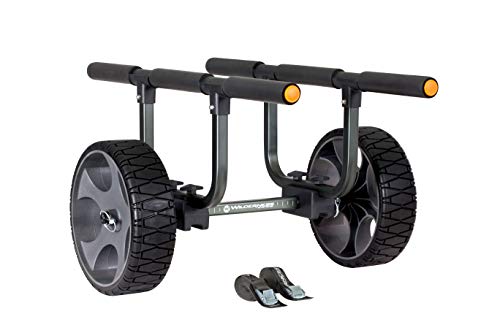
- 450-pound load capacity
- Adjustable bunker bar frame
- Two height settings and collapsible storage
Best For: Heavy or oddly shaped kayaks
Best for Soft Sand and Gravel
Bonnlo Kayak Cart with Balloon Wheels

- 12-inch low-pressure beach wheels
- 300-pound aluminum frame
- Includes pump and two ratchet straps
Best For: Beach launches and mixed sand-to-gravel routes
Best Value All-Terrain Capacity
VEVOR Kayak Cart with Solid Tires

- 450-pound load capacity
- 12-inch maintenance-free solid tires
- 170–440 mm adjustable width
Best For: Heavy kayaks on gravel, sand, grass, and uneven routes
Sand-Surface Specialist
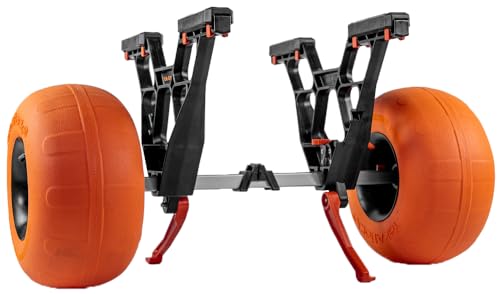
- 14-inch balloon tires suit sand and mud
- Adjustable padded bunks fit varied hulls
- 242-pound capacity with tool-free setup
Best For: Soft-surface launches and heavy kayaks
High-Capacity Hauler
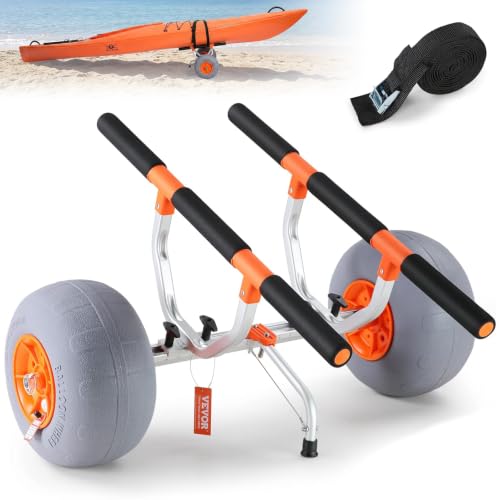
- Supports loads up to 350 pounds
- 13-inch wheels handle grass and sand
- Adjustable width and included tie-down straps
Best For: Heavy craft on soft or mixed surfaces
Flat-Free Compact Pick

- Airless wheels cannot go flat
- 3-inch mid-V platform stabilizes the hull
- Lightweight 9-pound frame carries 150 pounds
Best For: Light kayaks and dependable transport
Heavy-Duty Terrain Hauler

- 300-lb steel frame
- 16-inch no-flat wheels
- Adjustable width with padded supports
Best For: Rough paths, gravel, ramps, and packed sand
Maximum-Capacity Carrier
Pongnas Puncture-Proof Kayak Cart

- 500 kg stated capacity
- Puncture-proof TPE wheels
- 22–36-inch hull-width range
Best For: Large kayaks and heavy loads on gravel, sand, and rough terrain
Adjustable All-Rounder
Bonnlo 12-Inch Flat-Free Kayak Cart

- 450-lb capacity
- 6.3–18.7-inch adjustable width
- Kickstand and solid flat-free wheels
Best For: Varied terrain and kayaks with different hull widths
Best Compact Sand-Terrain Pick – RAILBLAZA C-Tug with SandTrakz Wheels
For kayak carts for rocky terrain and mixed outdoor routes, the RAILBLAZA C-Tug combines puncture-free SandTrakz wheels with a rust-resistant plastic frame. It carries up to 170 pounds and dismantles quickly for storage in most kayak hatches.
Best For: Paddlers who want a compact, easy-to-store cart for lighter kayaks and varied outdoor terrain.
Pros:
- SandTrakz all-terrain wheels are puncture-free.
- Rust-resistant construction supports repeated outdoor use.
- Includes a tie-down strap and has a five-year warranty.
- Designed to dismantle and fit inside most hatches.
Cons:
- Its 170-pound capacity is lower than the heavy-duty alternatives.
- The plastic construction may be less suitable for very heavy kayaks.
The C-Tug is a practical choice when portability matters as much as terrain handling. Check your fully loaded kayak’s weight before choosing it.
Best Heavy-Duty Frame – Wilderness Systems Heavy Duty Kayak Cart
Among kayak carts for rocky terrain, the Wilderness Systems Heavy Duty Kayak Cart stands out for its 450-pound load capacity and adjustable bunker bar frame. Its solid flat-free wheels, height options, and collapsible design target demanding kayak transport.
Best For: Heavy or unusually shaped kayaks that need a stable, adjustable transport cart.
Pros:
- Supports kayaks and canoes weighing up to 450 pounds.
- Adjustable-width bunker bars help prevent twisting and sideways slipping.
- Two height options accommodate odd-shaped hulls and lower the center of gravity.
- Collapses for storage in many kayak dry wells and storage areas.
Cons:
- At 13 pounds, it is heavier than the compact plastic cart.
- The supplied notes do not identify the solid wheels as pneumatic or puncture-free.
- It has a one-year manufacturer warranty.
This cart is built around capacity and hull stability rather than minimum weight. Its adjustable frame is especially useful when a kayak’s shape makes ordinary carts prone to rubbing or tipping.
Best for Soft Sand and Gravel – Bonnlo Kayak Cart with Balloon Wheels
For kayak carts for rocky terrain that also need to cross beaches, the Bonnlo trolley uses oversized 12-inch low-pressure balloon wheels. Its aluminum alloy frame supports up to 300 pounds, while the included ratchet straps help secure the kayak during transport.
Best For: Beach launches and mixed routes involving soft sand, gravel, wooded areas, or riverside paths.
Pros:
- Large balloon wheels are designed for soft sand and rough surfaces.
- Supports up to 300 pounds with an aluminum alloy frame.
- Includes two 7.75-foot ratchet straps for a firm hold.
- Comes with a free pump for the low-pressure wheels.
Cons:
- Balloon tires require inflation and use of the included pump.
- The kayak must be fully supported by the four foam bumpers to help prevent collapse.
- Correct kickstand and bow orientation are important during setup.
The Bonnlo is a versatile choice when soft sand is part of the launch route, but its inflatable wheel design requires more preparation than solid-tire carts.
Best Value All-Terrain Capacity – VEVOR Kayak Cart with Solid Tires
The VEVOR kayak cart is a strong option for kayak carts for rocky terrain when you want high capacity without inflatable tires. Its thickened aluminum alloy frame supports up to 450 pounds, and the 12-inch solid wheels are intended for gravel, sand, grass, and uneven sections.
Best For: Paddlers transporting heavy kayaks across varied terrain who prefer maintenance-free solid tires.
Pros:
- 450-pound load capacity accommodates heavy kayaks.
- 12-inch solid tires require no inflation or pressure checks.
- Adjustable width from 170 to 440 mm fits multiple watercraft types.
- Detachable design, single-foot support, and nonslip strap aid storage and securing.
Cons:
- The supplied notes do not specify a manufacturer warranty.
- Assembly and width adjustment are still required before use.
- The cart weighs 12.1 pounds, so it is not the lightest option.
With solid tires, broad adjustability, and a 450-pound rating, the VEVOR emphasizes straightforward transport over ultralight portability. Confirm the frame width suits your hull before buying.
Sand-Surface Specialist – YakAttack TowNStow Bunkster
For kayak carts for rocky terrain, the YakAttack TowNStow Bunkster stands out as a rugged, adjustable option with large pneumatic tires. Its 14-inch balloon tires are designed primarily for soft sand and mud, while the aluminum-and-stainless construction supports loads up to 242 pounds.
Best For: Paddlers who regularly move kayaks or SUPs across sand, mud, and mixed access areas and want adjustable hull support.
Pros:
- Large 14-by-7-inch air-filled tires with sealed hubs roll over soft surfaces without sinking as easily.
- Six bunk-width settings accommodate hulls from 6.25 to 16 inches wide.
- Tool-free setup, removable wheels, dual kickstands, and integrated tie-down points simplify loading and storage.
- Marine-grade materials and a 242-pound capacity provide substantial carrying capability.
Cons:
- Pneumatic sand tires can require inflation and are not specifically presented as puncture-proof.
- Cam straps are not included.
- The product is optimized for sand and mud, so rocky-terrain performance is not its primary stated use.
The Bunkster is a strong choice when soft-ground performance and high capacity matter most. For frequent sharp-rock travel, inspect the pneumatic tires and consider whether the terrain better suits a solid-wheel design.
High-Capacity Hauler – VEVOR Heavy Duty Kayak Cart
Among kayak carts for rocky terrain, the VEVOR Heavy Duty Kayak Cart offers a high 350-pound capacity and oversized 13-inch beach wheels intended to absorb shocks over grass, sand, and obstacle sections. However, the supplied notes specifically warn against gravel roads because the tires may break.
Best For: Users transporting heavy kayaks, canoes, paddleboards, or similar equipment over grass and sand rather than gravel.
Pros:
- Thickened aluminum-alloy frame is rated to carry up to 350 pounds.
- 13-inch wheels and bearings help the cart pass obstacle sections and soft ground.
- Adjustable carrier width fits 170 to 440 mm and supports multiple watercraft types.
- Includes two tie-down straps, a nonslip foot support, and tool-free assembly.
Cons:
- The manufacturer notes that it is not suitable for gravel roads because of tire-breakage risk.
- Beach-oriented tires may not be ideal for repeated sharp-rock use.
- At 15 pounds, it is heavier than the compact Suspenz option in this roundup.
Its capacity and broad adjustability make the VEVOR appealing for large loads and varied craft. Treat the gravel warning seriously: it is better matched to softer access routes than sustained rocky or gravel terrain.
Flat-Free Compact Pick – Suspenz DLX Kayak Cart
For kayak carts for rocky terrain, the Suspenz DLX offers a compact, lightweight design with airless wheels that cannot go flat. Its padded mid-V platform, rubber bumpers, and dual straps help stabilize and protect the hull during transport.
Best For: Kayakers who prioritize flat-free wheels, simple loading, and a light cart for transport loads up to 150 pounds.
Pros:
- Airless wheels eliminate the risk of flat tires during transport.
- The 3-inch-deep mid-V platform helps prevent rocking and load shifting.
- Quick-release wheels, fold-out design, and dual-leg kickstands make setup straightforward.
- Powder-coated 6061-T6 aluminum and stainless hardware resist rust, while rubber bumpers protect the hull.
Cons:
- The 150-pound capacity is lower than the other carts listed.
- Solid wheels may transmit more impact over uneven rocky ground than pneumatic tires.
- It is designed for transport, not storage.
The DLX is a practical choice when reliability and portability matter more than maximum capacity. Its airless wheels are reassuring on rough access paths, though the modest load rating and compact two-wheel format favor lighter kayaks.
Heavy-Duty Terrain Hauler – 16-Inch GanFindX Kayak Cart
For kayak carts for rocky terrain, the GanFindX combines a steel frame rated for up to 300 pounds with oversized 16-inch no-flat wheels. Its adjustable frame, foam padding, and included straps make it a practical choice for moving kayaks, canoes, or paddleboards over gravel, rough ground, ramps, and uneven paths.
Best For: Paddlers who need a sturdy cart for gravel, packed sand, ramps, and uneven routes from a vehicle to the water.
Pros:
- 300-pound steel-frame capacity supports kayaks, canoes, fishing kayaks, and paddleboards.
- 16-inch flat-free wheels are suited to grass, gravel, packed sand, and rough ground.
- Adjustable width accommodates different hull shapes.
- Foam support pads and tie-down straps help reduce shifting and hull marks.
Cons:
- Its listed 300-pound capacity is lower than the higher-rated carts in this roundup.
- The steel construction weighs 8.66 kg, so it may be less convenient to carry than lighter designs.
The large no-flat wheels and robust steel frame make this a sensible rocky-terrain option, especially when durability and simple storage matter more than minimum carry weight.
Maximum-Capacity Carrier – Pongnas Puncture-Proof Kayak Cart
Among kayak carts for rocky terrain, the Pongnas stands out for its stated 500 kg load capacity, dual-wheel axle, and deep-pattern puncture-proof TPE wheels. It is designed for sand, gravel, grass, wet docks, and uneven terrain, while its fold-flat aluminum-frame design keeps transport and storage manageable.
Best For: Users moving large watercraft or heavy loads across mixed terrain who want a high-capacity, no-inflation wheel system.
Pros:
- Reinforced frame and dual-wheel axle are rated for up to 500 kg.
- Puncture-proof, non-inflatable TPE wheels require no inflation checks.
- Fits hull widths from 22 to 36 inches and watercraft up to 18 feet.
- Folds flat with quick-release pins and weighs under 8.2 kg when assembled.
Cons:
- The unusually high 500 kg capacity should be checked against the intended watercraft and load before use.
- The supplied notes list a 90-day manufacturer warranty.
- Included components are listed as “no,” so buyers should verify the package contents.
Its broad fit range, foldable construction, and puncture-proof wheels make the Pongnas appealing for demanding terrain and larger loads, provided the stated capacity and package details match your needs.
Adjustable All-Rounder – Bonnlo 12-Inch Flat-Free Kayak Cart
The Bonnlo is a versatile pick among kayak carts for rocky terrain, pairing a 450-pound capacity with adjustable support bars that span 6.3 to 18.7 inches. Its 12-inch solid wheels, kickstand, padded bars, and long straps are intended to make loading and rolling kayaks or canoes easier across sand, lawns, and rough terrain.
Best For: Kayak owners who want broad hull compatibility, easy loading, and a strong cart for varied outdoor surfaces.
Pros:
- 450-pound capacity is supported by heat-treated, marine-grade aluminum bunker bars.
- Adjustable 6.3- to 18.7-inch bar spacing suits different kayak and canoe widths.
- Kickstand and padded support bars help with loading and hull contact.
- 12-inch flat-free wheels and included 11.8-foot straps support transport across rough terrain.
Cons:
- Its 12-inch wheels are smaller than the 16-inch wheels on the GanFindX.
- The listed item weight is 11.2 pounds, which may matter for users prioritizing the lightest setup.
- The notes do not specify a fold-flat storage design.
With a kickstand, precise width markings, and a two-year warranty, the Bonnlo is a practical middle ground for users who need adjustability and loading convenience without giving up substantial capacity.
How We Picked the Best Kayak Carts for Rocky Terrain
We focused on the features that matter most when a cart must cross rough ground rather than a smooth driveway. The selection includes models with airless, solid, puncture-free, balloon, or oversized beach-style wheels, along with frames designed for kayaks, canoes, and paddle boards.
We also compared stated load limits, adjustable width, hull support, strap systems, folding or detachable construction, and overall portability. Capacity figures are manufacturer ratings, so keep your kayak, seat, fishing gear, and other accessories within a comfortable margin below the maximum.
Quick Comparison
- Best all-terrain balance: Look for reinforced construction, wide wheels, and secure hull support.
- Best for sand and loose ground: Balloon or dedicated sand tires spread weight and reduce sinking.
- Best for rocks and gravel: Puncture-free or solid tires eliminate the risk of flats, while larger diameters roll more easily over obstacles.
- Best for heavier boats: Choose a cart with a high rated capacity and a sturdy frame, but verify that the hull supports match your boat.
- Best for storage: Detachable or folding carts are easier to carry inside a vehicle or stow aboard a kayak.
Key Buying Factors for Kayak Carts for Rocky Terrain
Wheel Design and Diameter
Rocky surfaces favor durable tires that cannot puncture and wheels large enough to clear small ledges. Wider tires can improve stability, while balloon wheels are useful on sand but may feel less precise on hard, uneven rock.
Frame Strength and Capacity
A reinforced frame helps prevent twisting when one wheel climbs over a rock. Select a rating that comfortably exceeds the fully loaded boat, not just its empty weight. Check whether the capacity applies evenly across the frame and wheels.
Hull Fit and Restraints
Adjustable bunks or width settings can make one cart useful with multiple boats. Straps, nonslip padding, and a cradle that matches the hull shape help prevent shifting on uneven terrain. A cart that fits poorly can be harder to control than a lighter model with better support.
Portability and Control
Consider the cart’s folded or detached size, handle clearance, kickstand, and ease of loading. For steep or rocky paths, a secure strap and a low, stable load position are more important than a high maximum capacity alone.
Who Should Buy Which Kayak Carts for Rocky Terrain?
Choose a puncture-free all-terrain cart if your routes regularly include gravel, exposed rocks, or mixed surfaces and reliability matters more than minimum weight.
Choose a beach-wheel model if soft sand is the main challenge, especially when carrying a wide or heavy fishing kayak. Confirm that the wheels still have adequate clearance for your rocky sections.
Choose a high-capacity heavy-duty cart for tandem kayaks, canoes, or heavily equipped fishing boats, provided the frame and hull supports fit securely.
Choose a compact detachable or folding design if you hike from parking areas, need to store the cart inside the kayak, or have limited vehicle space. Before buying, measure your hull and compare it with the cart’s width range and cradle dimensions.