Moving beyond entry-level sonar means choosing a fish finder that can keep pace with changing depths, unfamiliar water, and more deliberate fishing strategies. The best fish finder for intermediate anglers combines dependable sonar with useful navigation, a readable display, and controls you can operate without distraction.
This roundup compares 10 options across boat, kayak, ice-fishing, and portable setups. We focus on imaging capability, mapping, installation, screen size, portability, and overall value so you can match the technology to the way you fish.
Contents
- Best 10 Fish Finder for Intermediate Anglers Picks for 2026
- Versatile GPS Pick – Garmin Striker Vivid 7cv
- Mapping-Focused Choice – Humminbird HELIX 5 CHIRP GPS G3
- Compact Upgrade – Garmin Striker Vivid 4cv
- Premium Imaging Pick – Humminbird XPLORE 9
- Best All-Around Value – Garmin Striker 4
- Best Simple Sonar Setup – Humminbird PiranhaMAX 4
- Best for Mapping and Imaging – Lowrance HOOK Reveal 5
- Advanced Castable Mapping – Deeper PRO+ 2 Sonar
- Simple Boat Upgrade – Lowrance Eagle 4X Bullet
- Versatile Wireless Casting – Venterior Portable Fish Finder
- How We Picked the Best Fish Finder for Intermediate Anglers
- Quick Comparison
- Key Buying Factors for a Fish Finder for Intermediate Anglers
- Who Should Buy Which Fish Finder for Intermediate Anglers?
Best 10 Fish Finder for Intermediate Anglers Picks for 2026
Versatile GPS Pick

- 7-inch color display with vivid sonar palettes
- CHIRP traditional and ClearVü scanning sonar
- GPS, Quickdraw Contours, and Wi-Fi connectivity
Best For: All-around anglers wanting sonar, GPS, and mapping in one unit
Mapping-Focused Choice
Humminbird HELIX 5 CHIRP GPS G3

- Dual Spectrum CHIRP with Wide and Narrow modes
- Basemap covers 10,000+ lakes and U.S. coastlines
- AutoChart Live maps contours, hardness, and vegetation
Best For: Anglers focused on mapping and reliable keypad control
Compact Upgrade

- Space-saving 4-inch color display
- CHIRP and ClearVü sonar included
- GPS and Quickdraw Contours mapping
Best For: Small boats and anglers needing core features in a compact unit
Premium Imaging Pick

- MEGA Side and Down Imaging+ with 200-foot range
- 9-inch HD touchscreen plus keypad controls
- GPS, chart coverage, and network connectivity
Best For: Anglers wanting detailed imaging and expandable electronics integration
Best All-Around Value

- CHIRP and ClearVü sonar
- GPS waypoint mapping
- Compact, easy-to-use design
Best For: Intermediate anglers wanting versatile sonar and navigation
Best Simple Sonar Setup

- Dual-beam sonar
- 4.3-inch LCD display
- Adjustable tilt-and-swivel mount
Best For: Anglers wanting uncomplicated coverage options
Best for Mapping and Imaging

- FishReveal and DownScan Imaging
- Maps nearly 4,000 inland lakes
- 5-inch SolarMAX display
Best For: Inland anglers prioritizing mapping and structure detail
Advanced Castable Mapping
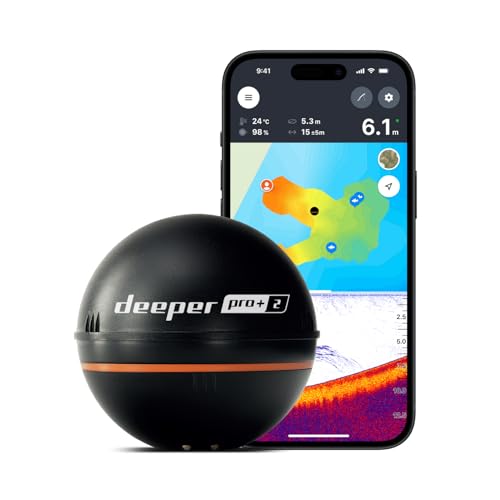
- Multiple beam options for broad or focused scanning
- Built-in GPS mapping through the Fish Deeper app
- 0.4-inch narrow-beam target separation
Best For: Intermediate anglers seeking detailed wireless sonar and mapping
Simple Boat Upgrade
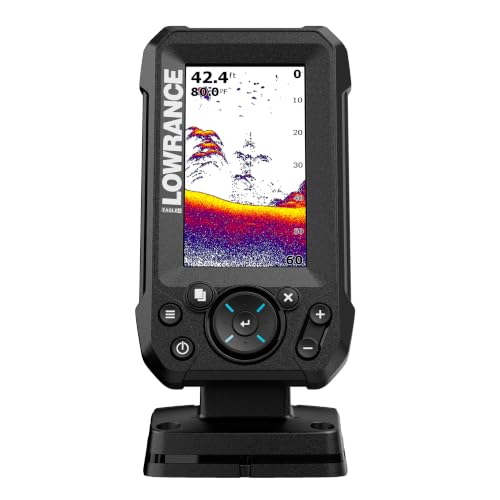
- Sun-readable 4-inch IPS portrait display
- Auto-Tuning Sonar simplifies operation
- 44-degree wide-angle Bullet Skimmer
Best For: Kayak and small-boat anglers wanting a dedicated display
Versatile Wireless Casting
Venterior Portable Fish Finder

- Wireless castable sensor reaches up to 262 feet
- Shows depth, temperature, fish size, and bottom contour
- Usable from shore, kayaks, boats, and ice
Best For: Mobile anglers needing a flexible castable sonar setup
Versatile GPS Pick – Garmin Striker Vivid 7cv
For intermediate anglers wanting a fish finder for intermediate anglers that balances screen space, sonar capability, and navigation, the Garmin Striker Vivid 7cv is a practical upgrade. Its 7-inch display, CHIRP sonar, GPS, and Quickdraw Contours mapping cover the essentials without making operation overly complicated.
Best For: Anglers who want a capable all-around fish finder with GPS and a generously sized display.
Pros:
- 7-inch color display with vivid scanning-sonar palettes for distinguishing fish and structure
- Includes CHIRP traditional sonar and CHIRP ClearVü scanning sonar
- Built-in GPS supports waypoints, routes, and boat-speed viewing
- Quickdraw Contours mapping and Wi-Fi connectivity add useful planning features
Cons:
- Larger and heavier than compact 4-inch options
- Wi-Fi features require a compatible smartphone and ActiveCaptain app
The Striker Vivid 7cv is a strong middle-ground choice for anglers ready to move beyond basic sonar. It provides useful navigation and mapping tools while retaining an easy-to-use layout.
Mapping-Focused Choice – Humminbird HELIX 5 CHIRP GPS G3
Humminbird Helix 5 G3 GPS Fish Finder with Transducer & Dual Spectrum Chirp Sonar
Check Price On AmazonThe Humminbird HELIX 5 CHIRP GPS G3 suits intermediate anglers who want dependable sonar alongside detailed mapping tools. Its Dual Spectrum CHIRP modes, preloaded Basemap, and AutoChart Live make it useful for learning productive areas and recording underwater contours.
Best For: Anglers who prioritize GPS mapping, target separation, and straightforward keypad operation.
Pros:
- Wide and Narrow Dual Spectrum CHIRP modes support broad or detailed searching
- Low-Q transducer provides precise 2D target separation
- Basemap includes coverage of more than 10,000 lakes and continental U.S. coastlines
- AutoChart Live records depth contours, bottom hardness, and vegetation
Cons:
- 5-inch screen is smaller than the display on the Garmin 7cv
- AutoChart Live includes eight hours of built-in recording time
- Premium chart compatibility may require additional chart products
Choose the HELIX 5 when mapping and practical control matter more than having the largest screen. Its keypad interface and charting features are especially useful for anglers building familiarity with new water.
Compact Upgrade – Garmin Striker Vivid 4cv
The Garmin Striker Vivid 4cv is a compact fish finder for intermediate anglers who need useful sonar and GPS without taking up much space. It includes CHIRP traditional and ClearVü scanning sonar, vivid color palettes, waypoint tools, and Quickdraw Contours mapping in a small bail-mounted unit.
Best For: Small boats and anglers who want a lightweight, space-saving unit with core Garmin features.
Pros:
- Compact 4-inch color display fits tighter helm spaces
- Includes GT20 transducer with CHIRP and ClearVü sonar
- GPS supports waypoints, routes, and boat-speed viewing
- Built-in Quickdraw Contours mapping adds basic mapping capability
Cons:
- Smaller screen offers less viewing area than 7-inch and 9-inch alternatives
- The supplied notes do not list Wi-Fi connectivity for this model
This model makes sense when installation space and portability are priorities. It delivers the main sonar and GPS functions intermediate anglers may need, though anglers who rely heavily on split-screen viewing may prefer a larger display.
Premium Imaging Pick – Humminbird XPLORE 9
Humminbird XPLORE 9 GPS Fish Finder with Transducer, MEGA Side Imaging+ & HD Touchscreen
Check Price On AmazonFor intermediate anglers ready for a more advanced fish finder, the Humminbird XPLORE combines a 9-inch HD touchscreen with MEGA Side Imaging+, MEGA Down Imaging+, GPS, and extensive connectivity. Its imaging range and dual-control interface are suited to anglers who want detailed views and room to expand their electronics setup.
Best For: Anglers seeking premium imaging, a large display, and compatibility with broader boat electronics.
Pros:
- MEGA Side Imaging+ and Down Imaging+ provide up to 200-foot imaging ranges
- 9-inch 1280-by-720 display supports touchscreen and keypad control
- Includes GPS, Humminbird Basemap, and LakeMaster/CoastMaster VX map coverage for the U.S. and Canada
- Ethernet, Bluetooth, and NMEA 2000 compatibility support system integration
Cons:
- More advanced than necessary for anglers seeking only basic sonar
- Its 9-inch display and 4.3-pound weight require more mounting space
- Listed maximum measuring depth is 200 feet
The XPLORE is the most feature-rich option in this group. It is a strong choice when detailed side and down imaging, a large screen, and integration with Minn Kota or Cannon equipment justify a more advanced setup.
Best All-Around Value – Garmin Striker 4
For anglers seeking a capable fish finder for intermediate anglers, the Garmin Striker 4 combines CHIRP sonar, ClearVü scanning, GPS waypoint marking, and a straightforward keyed interface in a compact 3.5-inch unit. It is a practical choice when you want useful detail without a complicated setup.
Best For: Intermediate anglers who want GPS navigation, detailed sonar, and a compact unit for freshwater or saltwater use.
Pros:
- CHIRP sonar provides crisper fish arches and improved target separation.
- ClearVü scanning sonar shows detailed representations of fish, objects, and structure.
- Waypoint mapping helps mark and navigate to brush piles, stumps, and docks.
- Built-in flasher mode supports ice fishing and vertical jigging.
Cons:
- The 3.5-inch display is smaller than the screens on the other listed options.
- The maximum depth rating is lower in saltwater than in freshwater.
The Striker 4 stands out as a versatile, easy-to-install option for anglers who value navigation and multiple sonar views in a small package.
Best Simple Sonar Setup – Humminbird PiranhaMAX 4
The Humminbird PiranhaMAX 4 is a straightforward fish finder for intermediate anglers who want a larger 4.3-inch display and flexible coverage without an overly complex feature set. Its dual-beam sonar lets you prioritize detail or a wider view beneath the boat.
Best For: Intermediate anglers who prefer simple dual-beam sonar and an adjustable display mount for everyday boat fishing.
Pros:
- Dual Beam Sonar offers a narrow beam for detail or a wide beam for broader coverage.
- The 4.3-inch LCD is larger than the Garmin Striker 4 display.
- Tilt-and-swivel mounting makes it easy to adjust the viewing angle.
- Includes the fish finder, mount, and transom-mount transducer.
Cons:
- Its listed maximum depth is 600 feet, below the Garmin’s stated depth capability.
- The supplied notes do not mention GPS mapping or imaging sonar.
Choose the PiranhaMAX 4 if your priority is uncomplicated sonar with selectable coverage and a more comfortable screen size for routine fishing trips.
Best for Mapping and Imaging – Lowrance HOOK Reveal 5
The Lowrance HOOK Reveal 5 is a strong fish finder for intermediate anglers who want a larger screen, detailed structure views, and built-in inland lake mapping. FishReveal combines CHIRP sonar with DownScan Imaging, while autotuning helps maintain a useful sonar image as conditions change.
Best For: Inland anglers who want fish-identification features, high-detail mapping, and a 5-inch daylight-visible display.
Pros:
- FishReveal makes fish easier to identify alongside DownScan structure imaging.
- Includes high-detail maps covering almost 4,000 U.S. inland lakes.
- Genesis Live supports custom contour maps over a map or GPS plotter.
- Autotuning sonar automatically adjusts settings as conditions change.
Cons:
- The supplied mapping coverage is specifically described for U.S. inland lakes.
- The unit uses a 12-volt DC power source, which may require suitable boat wiring or a battery setup.
With its 5-inch SolarMAX display, SplitShot transducer, imaging features, and mapping tools, the HOOK Reveal 5 is the most feature-rich choice here for inland anglers ready to refine their electronics setup.
Advanced Castable Mapping – Deeper PRO+ 2 Sonar
For intermediate anglers who want a fish finder for intermediate anglers that can do more than show basic depth, the Deeper PRO+ 2 combines castable sonar, multiple beam options, Wi-Fi connectivity, and built-in GPS mapping. Its compact wireless design works from shore, a kayak, boat, dock, or during ice fishing.
Best For: Intermediate anglers who want detailed target separation and GPS bathymetric mapping without installing a fixed display.
Pros:
- Wide, mid, and narrow beams support broad scanning or focused searching.
- Built-in GPS creates and saves bathymetric maps in the Fish Deeper app.
- Reports target separation down to 0.4 inches with the narrow beam.
- Wireless, lightweight design weighs just 3.2 ounces.
Cons:
- Uses a connected app rather than an integrated fish-finder screen.
- Its advanced mapping and beam features may be more than casual anglers need.
The Deeper PRO+ 2 is a strong upgrade for anglers ready to refine spot selection, lure tracking, and underwater mapping. Its 330-foot accuracy range and GPS features make it especially capable for mobile fishing setups.
Simple Boat Upgrade – Lowrance Eagle 4X Bullet
The Lowrance Eagle 4X Bullet is a practical fish finder for intermediate anglers who prefer a dedicated, easy-to-read display on a kayak or small boat. Its 4-inch IPS portrait screen, auto-tuning sonar, and included wide-angle transducer keep setup and operation straightforward.
Best For: Kayak and small-boat anglers who want an installed fish finder with automatic sonar settings and clear depth views.
Pros:
- 4-inch IPS screen remains visible in bright sunlight and through polarized sunglasses.
- Auto-Tuning Sonar reduces manual adjustment while fishing.
- Included 200 kHz Bullet Skimmer provides a broad 44-degree beam.
- Twist-lock connector supports quick display installation and removal.
Cons:
- Maximum listed measuring depth is 500 feet.
- The compact 4-inch display offers less viewing area than larger options.
- It requires mounting and wiring rather than offering a castable setup.
Choose the Eagle 4X Bullet if you want a conventional boat-mounted unit that emphasizes visibility and simplicity. Auto-tuning makes it approachable, while zoom and depth-marked fish icons provide useful identification tools.
Versatile Wireless Casting – Venterior Portable Fish Finder
The Venterior Portable Fish Finder is a flexible fish finder for intermediate anglers who move between shore, kayak, boat, and ice fishing. Its wireless castable sensor sends information to a handheld color display, showing depth, water temperature, fish size, fish depth, and bottom contour.
Best For: Mobile anglers who need a castable sensor and handheld readout for varied fishing environments.
Pros:
- Wireless sensor works up to 262 feet from the handheld unit.
- Displays depth, temperature, fish size, fish depth, and bottom contour.
- 105-degree sonar beam covers a broad area.
- Supports shore, kayak, boat, and ice fishing applications.
Cons:
- Maximum listed depth range is 164 feet.
- The 2.6-inch display is relatively compact.
- The supplied notes recommend switching to a white background for brighter sunlight.
This model suits anglers who value portability and basic underwater information over onboard installation. Its wireless range and broad beam make it useful when fishing from changing positions, while the rechargeable sensor avoids the need to drill through a hull.
How We Picked the Best Fish Finder for Intermediate Anglers
We evaluated these models by looking beyond basic depth readings. Intermediate anglers typically benefit from clearer target separation, dependable bottom tracking, GPS or mapping, and enough adjustability to interpret structure without making the system unnecessarily complicated.
We also considered transducer coverage, display size, installation requirements, portability, power needs, and the type of fishing each unit suits. The selection includes traditional CHIRP sonar, down- and side-imaging systems, chartplotter-style fish finders, and castable sonar for anglers who do not use a permanently mounted display.
Quick Comparison
| Type | Best suited to | What to prioritize |
|---|---|---|
| Compact mounted sonar | Small boats and tight consoles | Readable screen, simple controls, GPS if needed |
| Imaging fish finder | Structure-focused lake fishing | Side imaging, down imaging, transducer placement |
| GPS combo unit | Navigation and repeatable spots | Chart support, waypoint storage, mapping detail |
| Portable or castable sonar | Kayaks, shore fishing, and ice fishing | Battery life, wireless range, mounting flexibility |
Key Buying Factors for a Fish Finder for Intermediate Anglers
Sonar and Imaging
CHIRP sonar is a strong all-purpose choice because it can improve target separation and produce more useful returns across changing depths. Down imaging helps identify what is directly beneath the boat, while side imaging is valuable when scanning wider areas for cover, channels, and drop-offs. More advanced imaging is worthwhile only if you will use the extra information and can install the transducer correctly.
Screen Size and Controls
A larger display makes split-screen views and mapping easier to read, but it requires more console space and usually costs more. Touchscreens offer quick navigation, while physical buttons can be easier to use in cold, wet, or rough conditions. Choose the interface you can operate confidently while watching the water.
GPS, Maps, and Waypoints
GPS is useful for marking productive locations, following a route, and returning to structure. Built-in mapping varies considerably, so check whether the unit includes detailed charts, basic shoreline maps, or support for optional cartography. If you fish familiar water, waypoint storage may matter more than premium map detail.
Installation and Power
Confirm that the transducer suits your hull, trolling motor, or kayak setup. Portable units need dependable batteries and a practical mounting solution, while fixed displays need room for wiring and a secure installation point. Also verify voltage requirements and waterproofing before buying.
Who Should Buy Which Fish Finder for Intermediate Anglers?
Choose a compact Garmin STRIKER or Humminbird PiranhaMAX when you want straightforward depth and fish detection in a small boat. A Garmin STRIKER Vivid, Humminbird HELIX, or Lowrance HOOK Reveal is a better fit when you want a larger screen, GPS, mapping, or more detailed sonar tools.
Anglers who regularly search for submerged structure should consider a Humminbird XPLORE or another unit with advanced side-imaging capability. Kayak anglers, shore anglers, and ice fishermen may prefer the Deeper PRO+ 2 or a wireless portable sonar system because it avoids permanent installation. Before choosing, match the transducer and display to your boat, fishing environment, and willingness to manage setup complexity.