The best deep cycle battery depends on how much energy you need, how often you use it, and whether weight, maintenance, or upfront cost matters most. This lineup includes AGM lead-acid and LiFePO4 lithium options for RVs, boats, solar storage, and compact backup systems.
Use the comparisons below to match battery chemistry, capacity, size, and built-in protection features to your equipment before you buy.
Contents
- Best 10 Deep Cycle Batteries Picks for 2026
- Reliable AGM Power – Renogy 12V 100Ah AGM Battery
- Marine Dual-Purpose Pick – OPTIMA BLUETOP D34M AGM Battery
- Lightweight Lithium Option – NERMAK 12V 50Ah LiFePO4 Battery
- High-Capacity AGM Storage – Renogy 12V 200Ah AGM Battery
- Best Long-Life Lithium Upgrade – 12V 100Ah LiFePO4 Group 31 Battery
- Best Compact AGM Replacement – Interstate 12V 35Ah SLA Battery
- Best Group 31 Value for RVs – 12V 100Ah LiFePO4 Deep Cycle Battery
- Compact Marine Pick – Newport 12V 50Ah AGM Deep Cycle Battery
- Lightweight Lithium Value – SEFEPODER 12V 20Ah LiFePO4 2-Pack
- High-Capacity Marine Workhorse – Mighty Max 12V 100Ah AGM Marine Battery
- How We Picked These Deep Cycle Batteries
- Quick Comparison
- Key Buying Factors for Deep Cycle Batteries
- Who Should Buy Which Deep Cycle Batteries?
Best 10 Deep Cycle Batteries Picks for 2026
Reliable AGM Power

- Sealed AGM design with minimal maintenance
- Up to 1100A maximum five-second discharge
- Supports series and up to 4P parallel connections
Best For: RVs, cabins, and moderate solar backup systems
Marine Dual-Purpose Pick
OPTIMA BLUETOP D34M AGM Battery

- Combines starting and deep-cycle operation
- 750 CCA with 120-minute reserve capacity
- Sealed, maintenance-free AGM construction
Best For: Boats and RVs needing starting plus auxiliary power
Lightweight Lithium Option
NERMAK 12V 50Ah LiFePO4 Battery

- 4000+ cycle rating with low maintenance storage
- About 11 pounds with built-in 100A BMS
- Supports series and parallel expansion
Best For: Portable solar, camping, marine, and backup applications
High-Capacity AGM Storage

- 200Ah C20 reference capacity
- Maintenance-free sealed AGM construction
- Low self-discharge and broad temperature performance
Best For: Larger RV, solar, and off-grid storage systems
Best Long-Life Lithium Upgrade
12V 100Ah LiFePO4 Group 31 Battery

- Up to 15,000 cycles at 60% depth of discharge
- 100A Smart BMS with low-temperature cutoff
- 24-pound Group 31 replacement design
Best For: RV, marine, solar, and backup power users seeking lightweight, long-lasting capacity
Best Compact AGM Replacement
Interstate 12V 35Ah SLA Battery

- Sealed, spill-proof AGM/VRLA design
- Insert terminals with Group U1/GT9L sizing
- Made for compatible mobility equipment
Best For: Electric wheelchairs, scooters, and compact 12V deep-cycle applications
Best Group 31 Value for RVs
12V 100Ah LiFePO4 Deep Cycle Battery

- 100Ah lithium capacity in a Group 31 format
- Up to 15,000 cycles with a 10-year service-life claim
- Low-temperature charging cutoff and 100A Smart BMS
Best For: RV, trolling-motor, and off-grid systems needing lightweight 12V power
Compact Marine Pick
Newport 12V 50Ah AGM Deep Cycle Battery

- 50Ah 12V AGM power for trolling motors
- Sealed, low-maintenance marine construction
- Compact 32-pound design for smaller boats
Best For: Kayaks, jon boats, and small trolling-motor setups
Lightweight Lithium Value
SEFEPODER 12V 20Ah LiFePO4 2-Pack

- Two lightweight 20Ah lithium batteries
- Built-in BMS safety protection
- Rated for 4000+ cycles
Best For: Portable electronics, camping, fish finders, and power wheels
High-Capacity Marine Workhorse
Mighty Max 12V 100Ah AGM Marine Battery
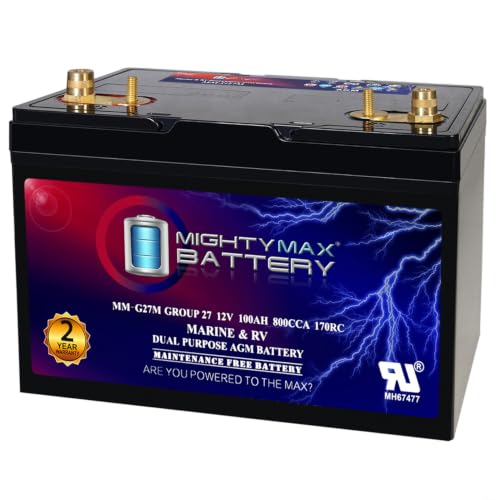
- 100Ah dual-purpose marine capacity
- 800 CCA and 850 MCA starting output
- Spill-proof, maintenance-free AGM construction
Best For: Boats needing starting power plus extended accessory runtime
Reliable AGM Power – Renogy 12V 100Ah AGM Battery
For dependable deep cycle batteries in an RV, cabin, or solar setup, this Renogy 12V 100Ah AGM model emphasizes safety, steady output, and minimal maintenance. Its sealed lead-acid design supports flexible connections and a low self-discharge rate when stored.
Best For: RVs, cabins, and solar users who want a maintenance-free AGM battery for common appliances and moderate off-grid power needs.
Pros:
- Sealed AGM construction offers exceptional chemical stability and minimal troubleshooting.
- Supports series connections without a stated limitation and parallel connections up to 4P.
- Provides up to 1100A of maximum discharge current for five seconds.
- Operates across a stated -4°F to 140°F range and has below-3% monthly self-discharge at 77°F.
Cons:
- At 63.9 pounds, it is substantially heavier than comparable lithium batteries.
- As a lead-acid AGM battery, it has lower cycle-life potential than the supplied LiFePO4 alternative.
- Its two-year coverage is prorated rather than a full replacement warranty.
This is a practical choice when sealed AGM simplicity and broad temperature performance matter more than minimizing weight. Verify the battery’s dimensions, terminal layout, and power requirements before installation.
Marine Dual-Purpose Pick – OPTIMA BLUETOP D34M AGM Battery
This OPTIMA BLUETOP is one of the more versatile deep cycle batteries in the group, combining starting power with deep-cycle capability. Its sealed AGM construction and vibration resistance make it suited to marine and RV applications where durability and convenience are priorities.
Best For: Boat and RV owners who need one maintenance-free battery for both engine starting and auxiliary deep-cycle use.
Pros:
- Dual-purpose design supports both starting and deep-cycle applications.
- Delivers 750 CCA, 870 MCA, and a 120-minute reserve capacity.
- SpiralCell technology uses 99.99% pure lead and is designed for strong performance in bad weather.
- Up to 15 times more vibration resistant than standard flooded batteries, according to the supplied specifications.
Cons:
- Its 55Ah C20 capacity is lower than the 100Ah and 200Ah Renogy options.
- The dual-purpose format may be less suitable for large standalone energy-storage demands.
- It weighs 43.5 pounds, so it is not the lightest option in this selection.
Choose this model when starting performance and marine durability are as important as auxiliary power. Its lower capacity makes it a better fit for dual-purpose service than extended off-grid storage.
Lightweight Lithium Option – NERMAK 12V 50Ah LiFePO4 Battery
For deep cycle batteries that prioritize low weight and long service life, the NERMAK 12.8V 50Ah LiFePO4 battery offers a compact alternative to lead acid. It includes a built-in 100A battery management system and supports series or parallel expansion.
Best For: Camping, marine equipment, trolling motors, wheelchairs, emergency lighting, and compact solar or backup systems where weight matters.
Pros:
- Rated for 4000+ cycles, substantially beyond the stated 200–500 cycles of traditional lead-acid batteries.
- At about 11 pounds, it weighs roughly one-third as much as a comparable lead-acid battery.
- Built-in 100A BMS helps protect against overcharge, over-discharge, over-current, and short circuits.
- Supports up to four identical batteries in series and accepts a stated 25A quick charge.
Cons:
- Its 50Ah capacity is lower than the two Renogy batteries in this roundup.
- It requires a LiFePO4-specific charger; a fully automatic SLA charger may not fully charge it.
- The supplied warranty is one year.
This NERMAK model is compelling when portability, cycle life, and maintenance-free storage outweigh maximum capacity. Confirm charger compatibility and ensure your application stays within its stated 50A continuous output.
High-Capacity AGM Storage – Renogy 12V 200Ah AGM Battery
When your setup needs more stored energy from a sealed lead-acid battery, this Renogy 12V 200Ah AGM model provides twice the nominal capacity of a 100Ah battery. Its low self-discharge, wide operating range, and maintenance-free construction suit larger RV and solar installations.
Best For: Higher-capacity RV, solar, and off-grid systems that can accommodate a heavy 200Ah AGM battery.
Pros:
- Provides 200Ah of rated capacity at the C20 reference rate.
- AGM construction helps avoid acid leakage and frequent maintenance.
- High-purity materials support a monthly self-discharge rate below 3% at 77°F.
- Specially treated grids enable high discharge currents, while the design remains suitable for low-temperature operation.
Cons:
- At 127.9 pounds, it is significantly heavier than the lithium model and smaller AGM option.
- Its large 20.5 x 9.4 x 8.8-inch footprint requires careful installation planning.
- Renogy recommends upright installation and prohibits upside-down installation.
This battery makes sense for users who need substantial AGM capacity and can support its weight and size. Account for depth of discharge, temperature, discharge rate, and recharge method when estimating service life.
Best Long-Life Lithium Upgrade – 12V 100Ah LiFePO4 Group 31 Battery
For shoppers comparing deep cycle batteries for RVs, boats, solar systems, or backup power, this 12V 100Ah LiFePO4 model emphasizes long service life, low weight, and built-in protection. Its Group 31 dimensions make it a practical replacement where compatible battery-box space is available.
Best For: RV house banks, marine trolling motors, off-grid solar, and home backup systems requiring lightweight, expandable power.
Pros:
- LiFePO4 chemistry with up to 15,000 cycles at 60% depth of discharge.
- Built-in 100A Smart BMS with overcharge, over-discharge, over-current, short-circuit, and low-temperature charging protection.
- weighs 24 pounds and fits BCI Group 31 battery boxes.
- Can be configured in series and parallel systems up to 4S4P.
Cons:
- Charging is automatically cut off below 32°F, so cold-weather charging requires planning.
- Requires a compatible LiFePO4 charging setup for proper charging.
This is a strong deep cycle battery choice for users prioritizing low maintenance, fast charging, and long-term cycle life. Confirm the dimensions, charging equipment, and system compatibility before replacing a lead-acid battery.
Best Compact AGM Replacement – Interstate 12V 35Ah SLA Battery
Those seeking deep cycle batteries for mobility equipment or compact 12V applications may prefer this sealed AGM model. Its 35Ah capacity, insert terminals, and Group U1/GT9L sizing are aimed at compatible wheelchairs, scooters, and other lower-capacity devices.
Best For: Electric wheelchairs, mobility scooters, and compatible compact equipment using a 12V 35Ah insert-terminal battery.
Pros:
- Sealed AGM/VRLA construction is rechargeable, maintenance-free, and spill-proof.
- Compact 12V, 35Ah format with insert terminals and included terminal hardware.
- Designed for deep-discharge mobility applications and backed by a 12-month performance warranty.
Cons:
- 35Ah capacity is substantially smaller than 100Ah options for larger RV or solar systems.
- Not a replacement for golf-cart batteries.
- Compatibility depends on matching the device, dimensions, and insert-terminal configuration.
This Interstate battery is a sensible replacement when a device specifically calls for a Group U1 or GT9L 12V 35Ah AGM battery. Check the compatibility guide and terminal style before ordering.
Best Group 31 Value for RVs – 12V 100Ah LiFePO4 Deep Cycle Battery
This 12V 100Ah LiFePO4 battery is built for shoppers upgrading to lithium deep cycle batteries in an RV or trolling-motor setup. It combines a Group 31 footprint with a 100A Smart BMS, low-temperature charging protection, and support for larger series-parallel systems.
Best For: RV house power, trolling motors, off-grid solar, and other systems needing a lightweight Group 31 lithium battery.
Pros:
- Rated for up to 15,000 cycles at 60% depth of discharge and a claimed 10-year service life.
- 24-pound, maintenance-free design is substantially lighter than comparable lead-acid batteries.
- Smart BMS protects against overcharge, over-discharge, over-current, and short circuits.
- Supports expansion up to four batteries in series and four parallel strings.
Cons:
- Charging below 32°F is disabled, which may affect cold-weather operation.
- Users must verify charger compatibility and available Group 31 space.
For an RV or marine user wanting lithium capacity without changing a Group 31 compartment, this model offers a compelling mix of weight savings, protection, and stated cycle life. Verify the system voltage and charging method before installation.
Compact Marine Pick – Newport 12V 50Ah AGM Deep Cycle Battery
If you need dependable power for a trolling motor or other 12V marine electronics, this Newport AGM battery is a practical deep cycle batteries option. Its sealed construction and 50Ah capacity suit smaller boats and regular days on the water.
Best For: Kayaks, jon boats, inflatable boats, and small trolling-motor setups.
Pros:
- 50Ah capacity provides steady 12V power for trolling motors and compatible electronics.
- Sealed AGM lead-acid construction is designed for low-maintenance marine use.
- Compact, portable design weighs 32 pounds and includes marine terminals.
Cons:
- At 50Ah, it offers less capacity than larger 100Ah marine batteries.
- Lead-acid construction is heavier than comparable lithium options.
This is a straightforward choice for anglers who want reliable, quiet electric power without moving to a larger battery bank. A one-year limited warranty and USA-based customer support add practical ownership reassurance.
Lightweight Lithium Value – SEFEPODER 12V 20Ah LiFePO4 2-Pack
This SEFEPODER two-pack is a lightweight alternative among deep cycle batteries for compact devices and portable power projects. Each 12.8V 20Ah LiFePO4 battery includes built-in protection and is designed for repeated cycling.
Best For: Fish finders, power wheels, lighting, routers, camping, and other compact 12V applications.
Pros:
- Two 20Ah LiFePO4 batteries provide flexible replacement or expansion options.
- Each battery weighs about 7.9 pounds, substantially reducing carrying weight versus lead-acid designs.
- Built-in BMS protection covers overcharge, overdischarge, overcurrent, and short circuits.
- Rated for 4000+ cycles and supports series or parallel connections within the stated limits.
Cons:
- Only 20Ah per battery, so this pack may not suit high-demand marine equipment.
- Requires a LiFePO4-specific charger; a standard SLA charger may not fully charge it.
- Uses F2 terminals, which may require compatible connectors.
For buyers prioritizing low weight and long cycle life, this pack is a versatile fit for smaller loads. Confirm charger compatibility and the intended connection configuration before installation.
High-Capacity Marine Workhorse – Mighty Max 12V 100Ah AGM Marine Battery
The Mighty Max MM-G27M combines 100Ah deep-cycle capacity with strong starting output, making it one of the more substantial deep cycle batteries for boats and off-grid use. Its dual-purpose design can start an engine while powering electronics and accessories.
Best For: Boat owners who need both engine-starting capability and extended accessory power.
Pros:
- 100Ah capacity supports longer-running marine electronics and gear.
- Provides 800 CCA and 850 MCA for dependable engine starting.
- Maintenance-free, spill-proof AGM design resists vibration and demanding conditions.
- Rugged ABS housing and stated rating of up to 700 cycles at 50% discharge add durability.
Cons:
- At 70.5 pounds, it is considerably heavier than compact lithium batteries.
- The larger Group 27M format may not fit every battery compartment.
- Its dual-purpose design may not replace a dedicated starting and house-battery system for every boat.
This battery makes sense when capacity and starting power matter more than portability. Check the compartment dimensions and electrical requirements carefully, especially because the listed measurements are approximately 12 by 6.62 by 9.25 inches.
How We Picked These Deep Cycle Batteries
We selected batteries across common deep-cycle use cases, including RV house banks, marine electronics, trolling motors, solar storage, and small backup systems. The list balances AGM and LiFePO4 designs, several capacity levels, marine and dual-purpose models, and compact batteries for lower-power applications.
We also considered nominal voltage, amp-hour capacity, battery chemistry, advertised cycle life, terminal style, built-in battery-management features, and compatibility with common 12-volt equipment. Always verify the manufacturer’s charging requirements, dimensions, terminal arrangement, and maximum continuous current before installation.
Quick Comparison
| Battery type | Typical strengths | Best suited for |
|---|---|---|
| AGM lead-acid | Lower upfront cost, sealed construction, broad compatibility | RVs, boats, backup power, moderate cycling |
| LiFePO4 lithium | Lower weight, longer cycle life, efficient usable capacity | Frequent cycling, solar storage, mobile power |
| Dual-purpose AGM | Starting and deep-discharge capability | Boats and systems needing both engine starting and house power |
| Small-capacity batteries | Compact size and easier installation | Electronics, small trolling motors, alarms, and modest backup loads |
Key Buying Factors for Deep Cycle Batteries
Capacity and Runtime
Amp-hours indicate how much charge a battery can store, but actual runtime depends on the load, inverter efficiency, temperature, and battery chemistry. A 100Ah battery is not automatically the right choice: calculate your expected watt-hours and include a reasonable reserve.
AGM Versus LiFePO4
AGM batteries are familiar, sealed, and often easier to substitute into existing systems. They are generally heavier and offer less usable capacity per rated amp-hour. LiFePO4 batteries cost more initially but typically provide more usable energy, much longer cycle life, and lower weight. Confirm that your charger, converter, solar controller, and low-temperature settings support lithium chemistry.
Physical Fit and Electrical Compatibility
Check group size, case dimensions, weight, terminal type, polarity, and cable clearance. For boats and RVs, secure mounting and ventilation requirements matter even with sealed batteries. Lithium models with a smart BMS may protect against overcharge, over-discharge, excessive current, and temperature conditions, but they do not replace correct system design.
Charging and Operating Conditions
Follow the specified charging voltage and current. Cold-weather charging is especially important for LiFePO4 batteries; use a model with low-temperature protection or a suitable heated installation when needed. Do not mix old and new batteries, or AGM and lithium batteries, in the same bank unless the system is specifically designed for it.
Who Should Buy Which Deep Cycle Batteries?
Choose an AGM model if you want a cost-conscious replacement for a conventional 12-volt deep-cycle setup, expect moderate use, or need broad charger compatibility. Choose LiFePO4 if you cycle the battery frequently, need to reduce system weight, or want more usable capacity over its service life.
Marine users should prioritize sealed construction, secure mounting, vibration resistance, and whether the battery must also provide engine-starting power. RV and solar users should focus on total daily energy consumption, charging hardware, and expansion plans. For small electronics or compact backup applications, a 20Ah to 50Ah battery may be more practical than a heavier 100Ah model.