Getting a kayak from your vehicle to the water can be harder than paddling it—especially when the route includes soft sand, loose gravel, roots, or uneven trails. The right cart reduces lifting, protects your gear, and makes longer carries far more manageable.
We’ve selected 10 heavy-duty kayak carts for rough terrain, covering puncture-free wheels, wide beach tires, adjustable frames, high weight capacities, and compact folding designs. Use the guide below to match the cart’s wheel style, frame support, and loading method to your launch conditions.
Contents
- Best 10 Kayak Carts for Rough Terrain Picks for 2026
- Top Heavy-Duty Pick – Suspenz All-Terrain Super Duty Cart
- Highest Capacity Option – VEVOR 450 lb Kayak Cart
- Soft-Sand Specialist – Bonnlo Balloon-Wheel Kayak Cart
- Largest-Wheel Pick – GanFindX 16-Inch Kayak Cart
- Heavy-Duty Adjustable Pick – 12-Inch Flat-Free Kayak Cart
- All-Terrain Sand Pick – C-Tug with SandTrakz Wheels
- Foldable Rough-Ground Pick – Bonnlo Airless-Tire Kayak Dolly
- Best All-Terrain Value – Ulticor Puncture-Free Kayak Cart
- Best Heavy-Duty Beach Option – VEVOR 350-Pound Kayak Cart
- Best High-Capacity Universal Pick – Bonnlo Adjustable Kayak Cart
- How We Picked These Kayak Carts for Rough Terrain
- Quick Comparison
- Key Buying Factors for Kayak Carts for Rough Terrain
- Who Should Buy Which Kayak Carts for Rough Terrain?
Best 10 Kayak Carts for Rough Terrain Picks for 2026
Top Heavy-Duty Pick
Suspenz All-Terrain Super Duty Cart

- 15-inch airless wheels for uneven routes
- Adjustable bunker bars for varied hull shapes
- Foldable steel frame with straps and kickstand
Best For: Heavy kayaks, canoes, and SUPs on rocky or uneven terrain
Highest Capacity Option

- 450-pound stated load capacity
- 12-inch solid tires need no inflation
- Adjustable width fits varied watercraft
Best For: High-load transport across gravel, sand, grass, and uneven ground
Soft-Sand Specialist
Bonnlo Balloon-Wheel Kayak Cart

- 12-inch low-pressure balloon wheels for sand
- 300-pound aluminum-alloy frame
- Two ratchet straps and included pump
Best For: Soft beach sand, gravel, and wooded launch routes
Largest-Wheel Pick

- 16-inch wheels for uneven launch routes
- 350-pound reinforced steel frame
- Foldable, adjustable, and ready to use
Best For: Heavier boats on sand, grass, gravel, and uneven ramps
Heavy-Duty Adjustable Pick

- 300-pound stated load capacity
- Adjustable padded support bars
- 12-inch airless wheels for bumpy ground
Best For: Larger kayaks and canoes on uneven terrain
All-Terrain Sand Pick

- Puncture-free SandTrakz tires
- Dismantles for hatch storage
- 170-pound stated capacity
Best For: Sandy launch areas and compact storage
Foldable Rough-Ground Pick
Bonnlo Airless-Tire Kayak Dolly

- 10-inch solid PU tires
- Folds for vehicle or hatch storage
- Includes kickstand and ratchet straps
Best For: Portable transport across mixed, uneven surfaces
Best All-Terrain Value
Ulticor Puncture-Free Kayak Cart

- Puncture-proof all-terrain wheels
- 260-pound kayak and canoe capacity
- Tool-free, compact disassembly
Best For: Portable transport across varied terrain
Best Heavy-Duty Beach Option
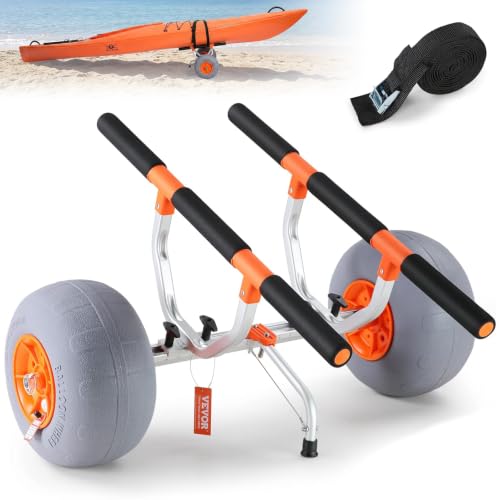
- 350-pound load capacity
- 13-inch beach wheels for sand and grass
- Adjustable and detachable aluminum frame
Best For: Heavy watercraft on sand or grassy paths
Best High-Capacity Universal Pick

- 450-pound weight capacity
- 6.3–18.7-inch adjustable bar spacing
- 12-inch solid wheels and kickstand
Best For: Heavy, varied-size kayaks on rough terrain
Top Heavy-Duty Pick – Suspenz All-Terrain Super Duty Cart
For demanding kayak carts for rough terrain, the Suspenz All-Terrain Super Duty Cart combines a steel frame, 15-inch airless wheels, and adjustable bunker bars. Its 350-pound stated capacity and hull-support features make it suited to heavier boats and uneven routes.
Best For: Heavy kayaks, canoes, and multiple SUPs traveling across rocky paths, paved ramps, or uneven terrain.
Pros:
- 15-inch airless wheels eliminate inflation and flat-tire concerns.
- Adjustable five-position bunker bars fit V-shaped, tunnel, catamaran, and flat-bottom hulls.
- Includes two cam-buckle strap sets, locking pins, and a spring-loaded kickstand.
- Folds to 31 by 16 by 9 inches for storage.
Cons:
- Its steel frame can rust in harsh or saltwater environments.
- At 17 pounds, it is heavier than some aluminum carts.
- The supplied notes list both a 350-pound load capacity and a 300-pound maximum weight detail, so buyers should verify the applicable rating.
This is a strong choice when stability, hull adjustability, and large maintenance-free wheels matter more than minimum carrying weight. Use corrosion protection if the cart will regularly encounter saltwater.
Highest Capacity Option – VEVOR 450 lb Kayak Cart
The VEVOR 450 lb Kayak Cart is a practical option among kayak carts for rough terrain when load capacity is a priority. Its thickened aluminum-alloy frame, 12-inch solid tires, and adjustable width support transport over gravel, sand, grass, and uneven sections.
Best For: Users who need a high-capacity cart for kayaks, canoes, paddleboards, Jon boats, or other compatible watercraft.
Pros:
- Rated to carry up to 450 pounds.
- 12-inch solid tires require no inflation or pressure checks.
- Adjustable 170-440 mm frame width accommodates multiple craft types.
- Detachable design and upgraded single-foot support simplify storage and stopping.
Cons:
- The 12-inch wheels are smaller than those on some all-terrain carts.
- Only one nonslip tie-down strap is listed as included.
- Assembly and disassembly may be less convenient than a fully foldable design.
Choose this cart if its 450-pound rating and broad compatibility outweigh the need for especially large wheels. The solid tires and aluminum frame are useful for regular trips across mixed terrain.
Soft-Sand Specialist – Bonnlo Balloon-Wheel Kayak Cart
For kayak carts for rough terrain that includes soft beaches, the Bonnlo Balloon-Wheel Kayak Cart uses large, low-pressure 12-inch wheels to reduce effort in sand. Its aluminum-alloy frame supports up to 300 pounds and includes two ratchet straps for securing the load.
Best For: Beach launches and transport over soft sand, gravel, wooded paths, and other uneven surfaces.
Pros:
- Low-pressure balloon wheels are designed to roll through soft sand.
- Aluminum-alloy frame has a 300-pound weight limit.
- Includes two 7.75-foot ratchet straps for a firm hold.
- Foam bumpers support the kayak, while the cart folds for storage.
Cons:
- Balloon tires require the included pump and may need pressure maintenance.
- Correct positioning of the kickstand, bow, and four foam bumpers is important for stability.
- The 300-pound limit is lower than the capacity of some heavy-duty alternatives.
This cart stands out for beach use, especially where narrow solid wheels may sink into soft sand. Confirm the kayak is fully supported and follow the recommended orientation before moving it.
Largest-Wheel Pick – GanFindX 16-Inch Kayak Cart
The GanFindX 16-Inch Kayak Cart is designed for kayak carts for rough terrain where larger wheels can help smooth travel over sandy beaches, grass, gravel, and uneven ramps. Its reinforced steel frame supports up to 350 pounds and folds for transport or storage.
Best For: Heavier kayaks, fishing kayaks, canoes, and paddleboards moved between vehicles, shorelines, docks, and ramps.
Pros:
- Large 16-inch wheels suit sand, grass, gravel, and uneven ramps.
- Reinforced steel frame supports up to 350 pounds.
- Adjustable frame helps fit different kayak sizes and hull shapes.
- Arrives ready to use and folds for storage in a trunk, garage, or boat compartment.
Cons:
- The steel construction is heavier than an aluminum alternative; the package weight is listed as 12 kg.
- Only one kayak cart is listed among the included components, with strap details described in the feature notes.
- The warranty is limited to one year.
This is a sensible pick when wheel diameter and ready-to-use convenience are key priorities. Its adjustable frame and built-in support stand also make solo loading more manageable.
Heavy-Duty Adjustable Pick – 12-Inch Flat-Free Kayak Cart
For shoppers comparing kayak carts for rough terrain, this heavy-duty model stands out for its 12-inch airless wheels, adjustable support bars, and high stated load capacity. Its aluminum frame and padded supports are designed for transporting larger kayaks and canoes over uneven ground.
Best For: Tandem, fishing, or pedal-drive kayaks that need a high-capacity cart with puncture-free wheels.
Pros:
- 300-pound maximum load capacity.
- 12-inch airless wheels roll over bumps without punctures.
- Support-bar spacing adjusts from 2.4 to 14.3 inches.
- Includes two 13.1-foot tie-down straps and padded support bars.
Cons:
- At 13.7 pounds, it is heavier than the listed foldable Bonnlo option.
- The large frame may be less convenient to store than a compact folding cart.
This is a strong choice when carrying capacity and wheel size matter most. The adjustable supports add versatility, while the airless wheels reduce puncture concerns on rougher paths.
All-Terrain Sand Pick – C-Tug with SandTrakz Wheels
Among kayak carts for rough terrain, the RAILBLAZA C-Tug is geared toward sand and outdoor launch areas with puncture-free SandTrakz wheels. Its rust-resistant construction, included tie-down strap, and dismantlable design make it practical for repeated trips.
Best For: Kayak, canoe, paddleboard, or surfboard owners who frequently cross sandy terrain and want a cart that can be dismantled for storage.
Pros:
- SandTrakz all-terrain wheels are designed for sand and are puncture-free.
- Rust-resistant construction supports repeated outdoor use.
- Can be dismantled to fit inside most hatches.
- Includes a five-year manufacturer warranty.
Cons:
- The stated capacity is 170 pounds, lower than the other listed carts.
- Its supplied details identify the frame material as plastic.
The C-Tug is a storage-friendly option for paddlers prioritizing sandy access routes and easy breakdown. Confirm that your loaded watercraft stays within the 170-pound stated limit.
Foldable Rough-Ground Pick – Bonnlo Airless-Tire Kayak Dolly
This Bonnlo trolley is a practical contender among kayak carts for rough terrain, using 10-inch by 3-inch solid PU tires intended for sand, lawns, and uneven ground. Its foldable aluminum design, kickstand, hull bumpers, and included ratchet straps add convenience from vehicle to shoreline.
Best For: Paddlers who want a lightweight, foldable cart for transporting kayaks across mixed surfaces and storing it in a vehicle or hatch.
Pros:
- Airless solid tires are designed for sand, lawns, and rough terrain.
- Folds down and can be packed into kayak hatches.
- Double kickstand and spring-loaded stand improve loading stability.
- Includes two ratchet straps and offers a two-year warranty.
Cons:
- Its 200-pound limit is below the 300-pound capacity of the first listed cart.
- The 10-inch wheels are smaller than the 12-inch wheels on that model.
Choose this cart when portability and stable loading matter alongside terrain capability. The solid tires avoid inflation maintenance, while the foldable frame is convenient for transport and storage.
Best All-Terrain Value – Ulticor Puncture-Free Kayak Cart
For paddlers comparing kayak carts for rough terrain, the Ulticor combines puncture-proof wheels, a 260-pound capacity, and a strap system designed to help keep the boat secure on uneven ground. Its tool-free assembly and compact storage make it practical for regular use.
Best For: Kayak and canoe owners who want a lightweight, puncture-free cart for varied terrain and easy storage.
Pros:
- Puncture-proof all-terrain wheels eliminate flat-tire concerns.
- Supports kayaks and canoes up to 260 pounds.
- Adjustable straps, a toggle lock, and hull pads help stabilize the watercraft.
- Assembles and disassembles without tools and weighs about 10 pounds.
Cons:
- The 260-pound capacity is lower than the heavier-duty options in this roundup.
- The supplied material details list the frame material as plastic.
The Ulticor is a well-rounded choice when flat-free wheels and portability matter more than maximum load capacity. Its reinforced components and adjustable securing system make it especially appealing for uneven launch paths.
Best Heavy-Duty Beach Option – VEVOR 350-Pound Kayak Cart
Among kayak carts for rough terrain, the VEVOR stands out for its thickened aluminum frame, 350-pound load rating, and large 13-inch beach wheels. The wheels are intended to handle sand, grass, and obstacles, though the manufacturer cautions against gravel roads.
Best For: Owners moving heavier kayaks, canoes, paddleboards, or similar watercraft over sand and grass.
Pros:
- Supports up to 350 pounds with a 2 mm thickened aluminum-alloy frame.
- 13-inch wheels help absorb shocks and cross sand, grass, and obstacle sections.
- Adjustable carrier width fits approximately 170–440 mm and supports multiple watercraft types.
- Detachable, tool-free assembly takes about two minutes.
Cons:
- The notes specifically warn that it is not suitable for gravel roads because of possible tire breakage.
- At about 15 pounds, it is heavier than the Ulticor.
This VEVOR model is a strong fit for high-load transport on softer terrain. Its beach-oriented wheels and broad application range are useful, but gravel users should choose a cart designed for that surface.
Best High-Capacity Universal Pick – Bonnlo Adjustable Kayak Cart
The Bonnlo is a versatile choice among kayak carts for rough terrain, pairing a 450-pound capacity with adjustable bunker bars and 12-inch solid wheels. Its kickstand and padded supports are designed to simplify loading while keeping the kayak positioned during transport.
Best For: Paddlers who need a highly adjustable cart with a high weight rating for sand, lawns, and rough terrain.
Pros:
- 450-pound capacity provides the highest stated load rating in this selection.
- Adjustable bar spacing from 6.3 to 18.7 inches accommodates different hull widths and keels.
- 12-inch solid wheels are designed for sand, lawns, and rough terrain.
- Kickstand, padded support bars, two straps, and a two-year warranty add convenience.
Cons:
- The 12-inch wheels are smaller than the VEVOR’s 13-inch beach wheels.
- Its universal adjustment may require measuring and positioning the bars for each kayak.
Choose the Bonnlo when capacity and fit flexibility are priorities. The measurement markings, kickstand, and solid wheels make it a practical heavy-duty option for varied non-gravel surfaces.
How We Picked These Kayak Carts for Rough Terrain
We focused on the features that matter most beyond smooth pavement: large or wide wheels, puncture-resistant construction, stable frames, useful load ratings, and adjustable support points. Models with solid or airless tires can reduce maintenance, while balloon-style beach wheels are designed to spread weight over softer ground. We also considered portability, because a cart that is difficult to store or attach may be left behind when you need it most.
Published capacity is only part of the picture. Your kayak, seat, cooler, fishing equipment, and dry bags all contribute to the real load, so we favored carts with practical capacity headroom and secure tie-down options.
Quick Comparison
| Feature | Why It Matters | Best For |
|---|---|---|
| Wide beach wheels | Reduce sinking on sand | Beach launches and soft ground |
| Solid or airless tires | Prevent punctures and simplify maintenance | Rocky paths and frequent use |
| Adjustable frame | Improves fit across hull shapes | Multiple kayaks or canoes |
| High weight capacity | Provides more safety margin | Fishing and fully loaded kayaks |
| Folding or detachable design | Makes transport and storage easier | Small vehicles and limited storage |
Key Buying Factors for Kayak Carts for Rough Terrain
Wheel Design
For sand, choose broad balloon or beach wheels that distribute pressure instead of cutting into the surface. For gravel, roots, and mixed trails, puncture-free solid or airless wheels can be more dependable. Larger wheels generally roll over obstacles more easily than small wheels.
Frame Fit and Stability
Check the cart’s adjustable width, bunk or cradle shape, and strap arrangement. A stable cart should support the kayak near its balance point without shifting sideways. Confirm that the frame fits your hull before buying, particularly with wide, flat-bottomed, or unusually shaped kayaks.
Capacity and Construction
Choose a rated capacity comfortably above the fully loaded weight. Reinforced frames are useful for heavier fishing kayaks, but they may add weight. Also check whether the cart uses corrosion-resistant hardware if it will regularly contact saltwater.
Portability and Attachment
Folding and detachable carts are easier to keep in a hatch, trunk, or vehicle. Consider how quickly the cart attaches, whether the straps are included, and whether you can load the kayak without assistance.
Who Should Buy Which Kayak Carts for Rough Terrain?
Choose a wide-wheel beach cart if most launches involve sand or dunes. Pick a solid-wheel all-terrain model for rocky access roads, gravel, and trails where punctures are a concern. A high-capacity adjustable cart is the better choice for heavy fishing kayaks or kayaks loaded with equipment. If storage space is limited, prioritize a foldable or quick-disassembly design—even if its capacity is slightly lower.
Before purchasing, measure your kayak’s width and hull shape, estimate the fully loaded weight, and compare those figures with the cart specifications. The best cart is the one that matches your terrain and remains stable, manageable, and easy to store after the launch.